Note
Go to the end to download the full example code or to run this example in your browser via JupyterLite.
Forecasting with (Nonlinear) AR models#
In this examples, we will demonstrate how to use make_narx() to build (nonlinear)
AutoRegressive (AR) models for time-series forecasting.
The time series used is the monthly average atmospheric CO2 concentrations
from 1958 and 2001.
The objective is to forecast the CO2 concentration till nowadays with
initial 18 months data.
Credit
The majority of code is adapted from the scikit-learn tutorial Forecasting of CO2 level on Mona Loa dataset using Gaussian process regression (GPR).
# Authors: The fastcan developers
# SPDX-License-Identifier: MIT
Prepare data#
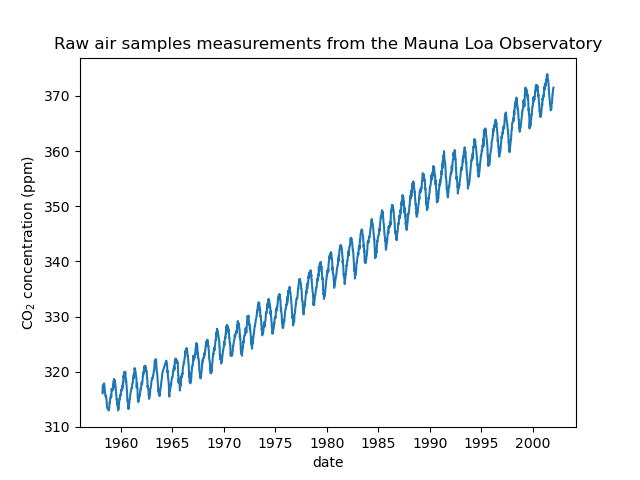
We use the data consists of the monthly average atmospheric CO2 concentrations (in parts per million by volume (ppm)) collected at the Mauna Loa Observatory in Hawaii, between 1958 and 2001.
from sklearn.datasets import fetch_openml

co2 = fetch_openml(data_id=41187, as_frame=True)
co2 = co2.frame
co2.head()
First, we process the original dataframe to create a date column and select it along with the CO2 column. Here, date columns is used only for plotting, as there is no inputs (including time or date) required in AR models.
import pandas as pd

co2_data = co2[["year", "month", "day", "co2"]].assign(
    date=lambda x: pd.to_datetime(x[["year", "month", "day"]])
)[["date", "co2"]]
co2_data.head()
The CO2 concentration are from March, 1958 to December, 2001, which is shown in the plot below.
import matplotlib.pyplot as plt

plt.plot(co2_data["date"], co2_data["co2"])
plt.xlabel("date")
plt.ylabel("CO$_2$ concentration (ppm)")
_ = plt.title("Raw air samples measurements from the Mauna Loa Observatory")
We will preprocess the dataset by taking a monthly average to smooth the data.
The months which have no measurements were collected should not be dropped.
Because AR models require the time intervals between the two neighboring measurements
are consistent.
As the results, the NaN values should be kept as the placeholders to maintain the
time intervals, and NARX can handle the missing values properly.
co2_data = co2_data.set_index("date").resample("ME")["co2"].mean().reset_index()
plt.plot(co2_data["date"], co2_data["co2"])
plt.xlabel("date")
plt.ylabel("Monthly average of CO$_2$ concentration (ppm)")
_ = plt.title(
    "Monthly average of air samples measurements\nfrom the Mauna Loa Observatory"
)
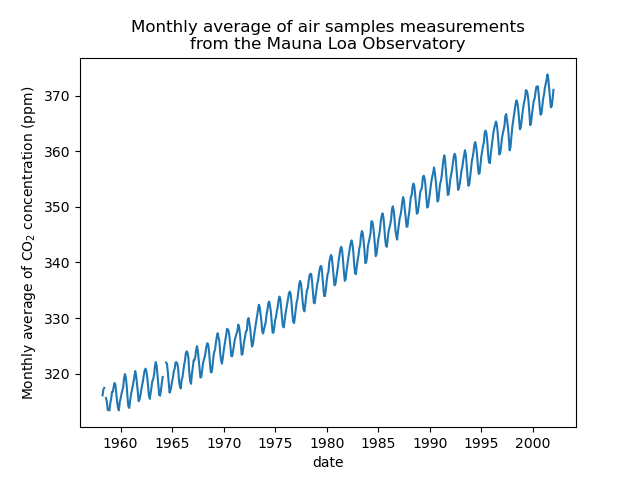
For plotting, the time axis for training is from March, 1958 to December, 2001, which is converted it into a numeric, e.g., March, 1958 will be converted to 1958.25. The time axis for test is from March, 1958 to nowadays.
Nonlinear AR model#
We can use make_narx() to easily build a nonlinear AR model, which does not
has an input. Therefore, the input X is set as None.
make_narx() will search 10 polynomial terms, whose maximum degree is 2 and
maximum delay is 9.
from fastcan.narx import make_narx, print_narx

max_delay = 9
model = make_narx(
    None,
    co2_data["co2"],
    n_terms_to_select=10,
    max_delay=max_delay,
    poly_degree=2,
    verbose=0,
)
model.fit(None, co2_data["co2"], coef_init="one_step_ahead")
print_narx(model, term_space=27)
| yid |           Term            |   Coef   |
|-----|---------------------------|----------|
|  0  |         Intercept         | -14.881  |
|  0  |       y_hat[k-1,0]        |  1.291   |
|  0  |       y_hat[k-2,0]        |  -0.203  |
|  0  |       y_hat[k-3,0]        |  -0.438  |
|  0  |       y_hat[k-5,0]        |  0.327   |
|  0  |       y_hat[k-8,0]        |  -0.578  |
|  0  |       y_hat[k-9,0]        |  0.688   |
|  0  | y_hat[k-2,0]*y_hat[k-6,0] |  -0.000  |
|  0  | y_hat[k-6,0]*y_hat[k-6,0] |  -0.046  |
|  0  | y_hat[k-6,0]*y_hat[k-7,0] |  0.091   |
|  0  | y_hat[k-7,0]*y_hat[k-7,0] |  -0.046  |
Forecasting performance#
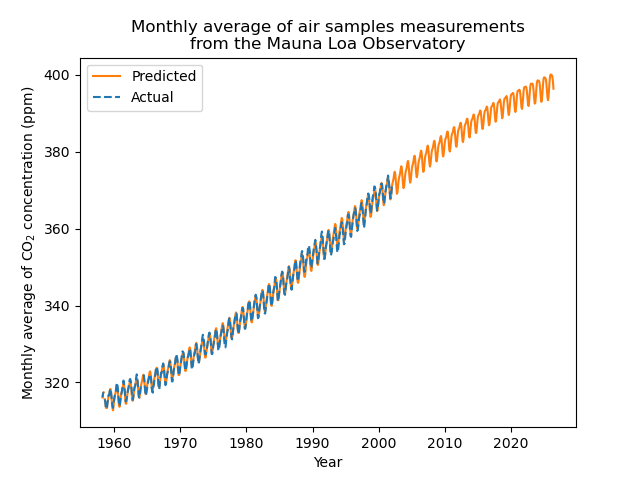
As AR model does not require input data, the input X in predict()
is used to indicate total steps to forecast. The initial conditions y_init
is the first 18 months data from the ground truth, which contains missing values.
If there is no missing value given to y_init, we can only use max_delay
number of samples as the initial conditions.
However, if missing values are given to y_init, NARX will break
the data into multiple time series according to the missing values. For each
time series, at least max_delay number of samples, which does not have
missing values, are required to do the proper forecasting.
The results show our fitted model is capable to forecast to future years with
only first 18 months data.
y_pred = model.predict(
    len(x_test),
    y_init=co2_data["co2"][:18],
)
plt.plot(x_test, y_pred, label="Predicted", c="tab:orange")
plt.plot(x_train, co2_data["co2"], label="Actual", linestyle="dashed", c="tab:blue")
plt.legend()
plt.xlabel("Year")
plt.ylabel("Monthly average of CO$_2$ concentration (ppm)")
_ = plt.title(
    "Monthly average of air samples measurements\nfrom the Mauna Loa Observatory"
)
plt.show()
Total running time of the script: (0 minutes 4.285 seconds)
